Functions
- manim_extensions.gearbox.involute_func(t, r, a=0, rad_offs=0, tan_offs=0)[source]
Returns the x-y-z values of the involute function.
- Parameters:
t (input angle or sequence of angles.)
r (base circle radius.)
a (offset angle.)
rad_offs (radial offset.)
tan_offs (tangential offset.)
Examples
Example: InvoluteFuncDocExample 
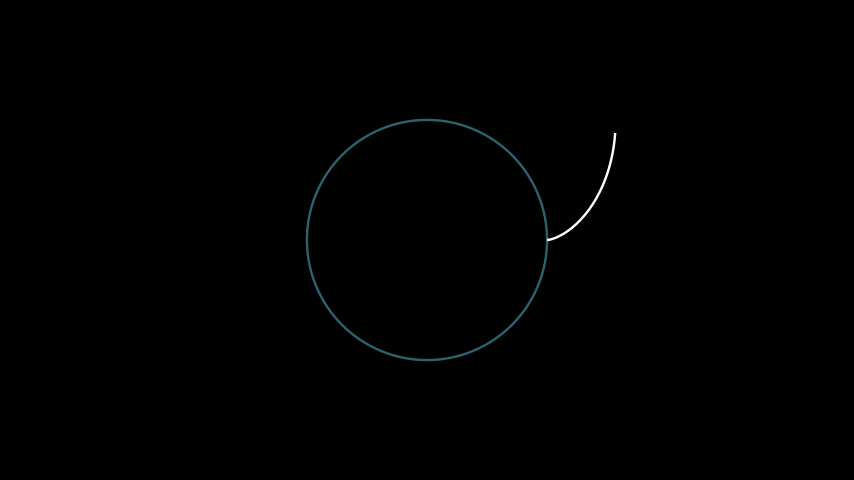
from manim import *
from manim_extensions.gearbox import involute_func

class InvoluteFuncDocExample(Scene):
    def construct(self):
        r = 2
        t = np.linspace(0, 1.5, 100)
        points = involute_func(t, r)
        curve = VMobject(stroke_color=WHITE)
        curve.set_points_as_corners(points)
        base = Circle(radius=r, color=BLUE, stroke_opacity=0.5)
        self.add(base, curve)
from manim import *
from manim_extensions.gearbox import involute_func

class InvoluteFuncDocExample(Scene):
    def construct(self):
        r = 2
        t = np.linspace(0, 1.5, 100)
        points = involute_func(t, r)
        curve = VMobject(stroke_color=WHITE)
        curve.set_points_as_corners(points)
        base = Circle(radius=r, color=BLUE, stroke_opacity=0.5)
        self.add(base, curve)
- manim_extensions.gearbox.involute_deriv_func(t, r, a=0, rad_offs=0, tan_offs=0)[source]
Return the derivative of the involute function at angle t.
- Parameters:
t (angle or sequence of angles at which to evaluate the derivative.)
r (base circle radius.)
a (offset angle.)
rad_offs (radial offset.)
tan_offs (tangential offset.)
Examples
Example: InvoluteDerivFuncDocExample 
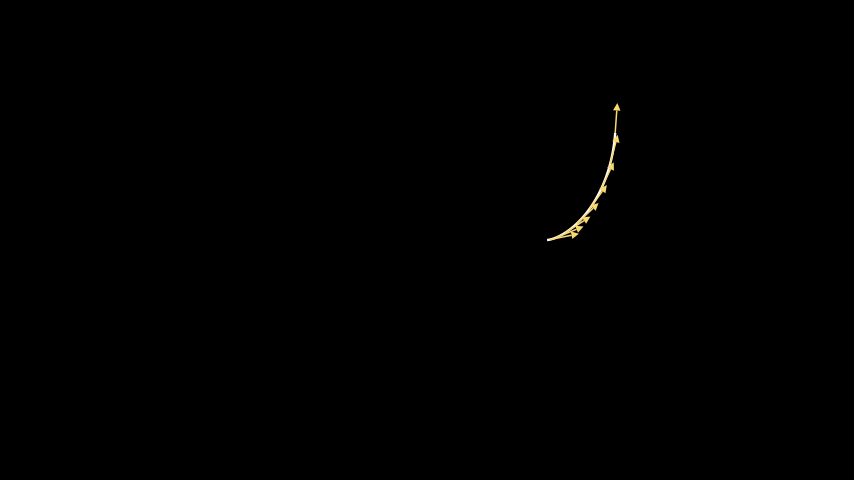
from manim import *
from manim_extensions.gearbox import involute_func, involute_deriv_func

class InvoluteDerivFuncDocExample(Scene):
    def construct(self):
        r = 2
        t_curve = np.linspace(0, 1.5, 100)
        t_samples = np.linspace(0.2, 1.5, 8)
        curve = VMobject(stroke_color=WHITE)
        curve.set_points_as_corners(involute_func(t_curve, r))
        self.add(curve)
        for p, d in zip(involute_func(t_samples, r), involute_deriv_func(t_samples, r)):
            direction = 0.5 * d / np.linalg.norm(d)
            self.add(Arrow(p, p + direction, buff=0, color=YELLOW))
from manim import *
from manim_extensions.gearbox import involute_func, involute_deriv_func

class InvoluteDerivFuncDocExample(Scene):
    def construct(self):
        r = 2
        t_curve = np.linspace(0, 1.5, 100)
        t_samples = np.linspace(0.2, 1.5, 8)
        curve = VMobject(stroke_color=WHITE)
        curve.set_points_as_corners(involute_func(t_curve, r))
        self.add(curve)
        for p, d in zip(involute_func(t_samples, r), involute_deriv_func(t_samples, r)):
            direction = 0.5 * d / np.linalg.norm(d)
            self.add(Arrow(p, p + direction, buff=0, color=YELLOW))
- manim_extensions.gearbox.involute_height_func(k, r, **kwargs)[source]
Returns the radial height of the involute compared to the base circle.
- Parameters:
k (angle or sequence of angles.)
r (base circle radius.)
**kwargs (forwarded to
involute_func().)
Examples
Example: InvoluteHeightFuncDocExample 
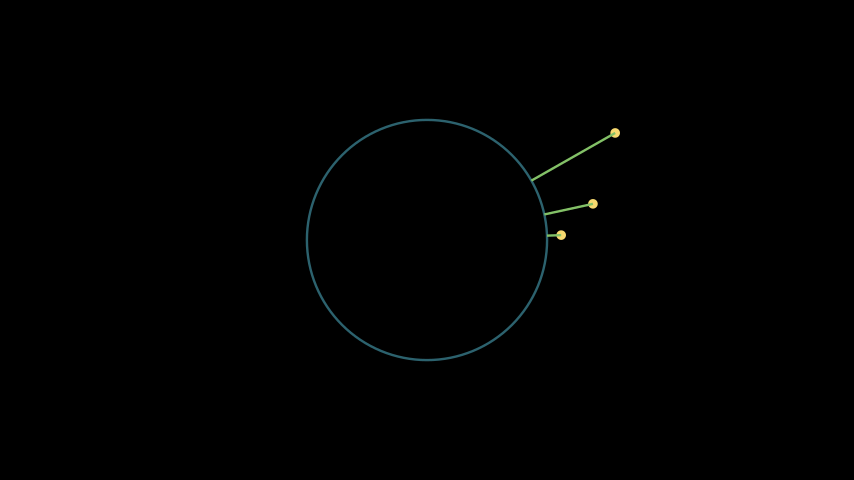
from manim import *
from manim_extensions.gearbox import involute_func, involute_height_func

class InvoluteHeightFuncDocExample(Scene):
    def construct(self):
        r = 2
        t = np.array([0.5, 1.0, 1.5])
        points = involute_func(t, r)
        base = Circle(radius=r, color=BLUE, stroke_opacity=0.5)
        self.add(base)
        for p in points:
            self.add(Dot(p, color=YELLOW))
            base_point = r * p / np.linalg.norm(p)
            self.add(Line(base_point, p, color=GREEN))
from manim import *
from manim_extensions.gearbox import involute_func, involute_height_func

class InvoluteHeightFuncDocExample(Scene):
    def construct(self):
        r = 2
        t = np.array([0.5, 1.0, 1.5])
        points = involute_func(t, r)
        base = Circle(radius=r, color=BLUE, stroke_opacity=0.5)
        self.add(base)
        for p in points:
            self.add(Dot(p, color=YELLOW))
            base_point = r * p / np.linalg.norm(p)
            self.add(Line(base_point, p, color=GREEN))
- manim_extensions.gearbox.involute_point_gen(t, r, **kwargs)[source]
Returns a list of points to be for cubic bezier approximation of the involute curve. Output is compatible with Mobject.points. Input t is a list where the involute shall be evaluated, it can be unevenly spaced. Anchors are added automatically.
- Parameters:
t (sequence of angles at which to evaluate the involute.)
r (base circle radius.)
**kwargs (forwarded to
involute_func()andinvolute_deriv_func().)
Examples
Example: InvolutePointGenDocExample 
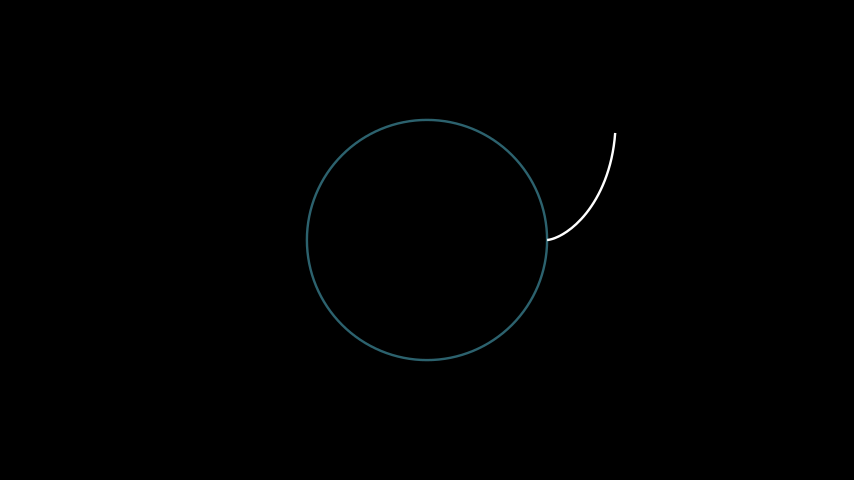
from manim import *
from manim_extensions.gearbox import involute_point_gen

class InvolutePointGenDocExample(Scene):
    def construct(self):
        r = 2
        t = np.linspace(0, 1.5, 6)
        points = involute_point_gen(t, r)
        curve = VMobject(stroke_color=WHITE)
        curve.points = points
        base = Circle(radius=r, color=BLUE, stroke_opacity=0.5)
        self.add(base, curve)
from manim import *
from manim_extensions.gearbox import involute_point_gen

class InvolutePointGenDocExample(Scene):
    def construct(self):
        r = 2
        t = np.linspace(0, 1.5, 6)
        points = involute_point_gen(t, r)
        curve = VMobject(stroke_color=WHITE)
        curve.points = points
        base = Circle(radius=r, color=BLUE, stroke_opacity=0.5)
        self.add(base, curve)